Dr. Dabber Switch 2 vs Switch Go: What's the Difference?
Posted:June 14, 2026
AGE VERIFICATION
The products available on Element Vape are age-restricted and intended
for adults of legal smoking age only. All orders placed on the website will
be verified by an industry leading Age Verification software for validation.
By entering our website, you affirm that you are of legal smoking age in your
jurisdication and you agree to be Age Verified.
Dr. Dabber has spent over a decade pushing concentrate vaporizer technology forward, trailblazing a new path for the industry as seen with their Switch series. In 2018, the original Switch was released and made waves for its induction heating, dual functionality, and long-lasting battery life. The Switch 2 followed in 2024, doubling down on precision and tabletop performance. Then came the Switch Go in 2026; same family, different mission.
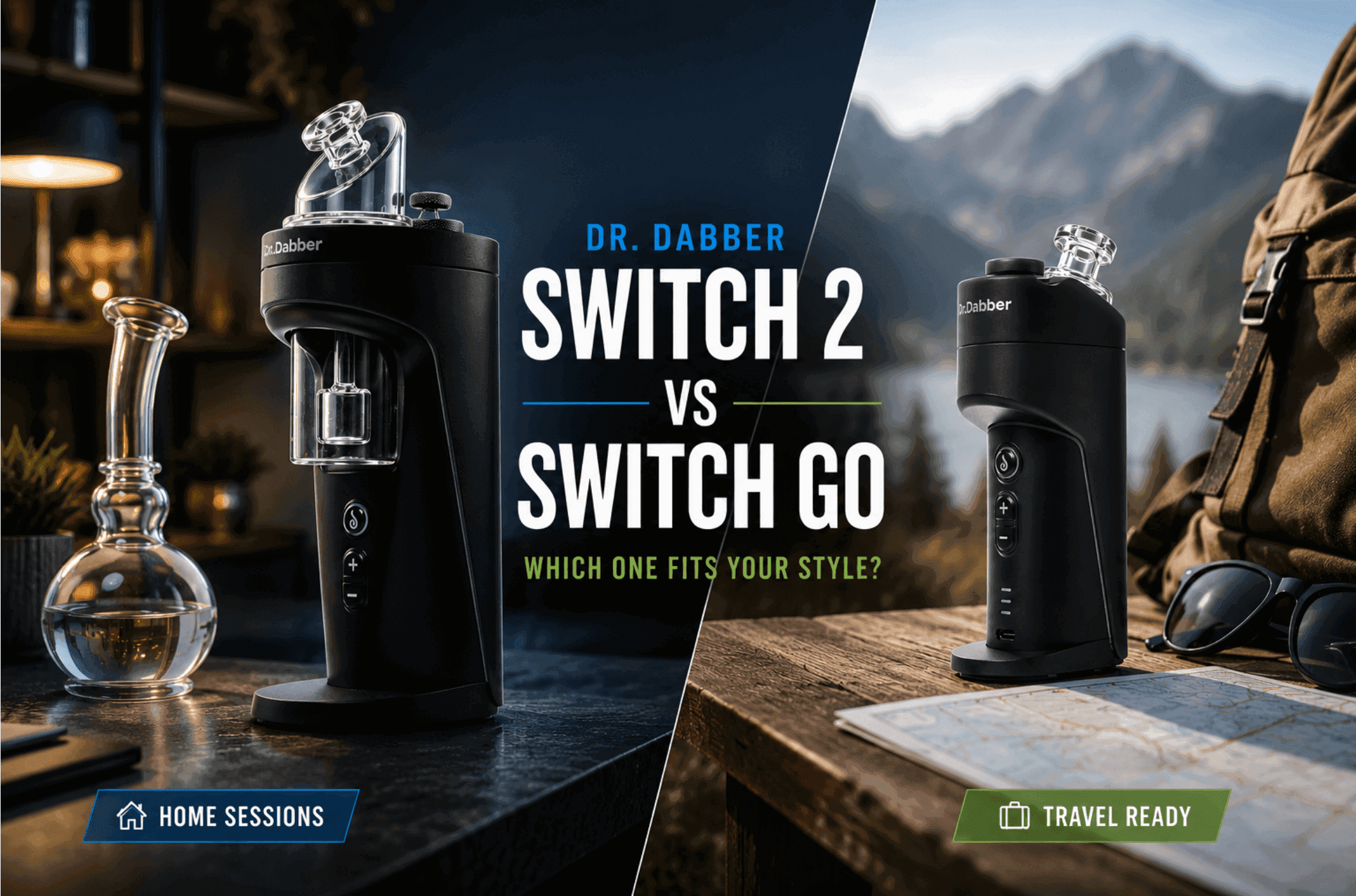
While all products in the Dr. Dabber Switch series share the same DNA, they differ vastly when it comes to purpose. That's especially evident in the Switch 2 and Switch Go, where both devices share the same tapered profile, omni-directional induction heating, and app-enabled customization which is why they look like cousins on paper. But dig a little deeper and it becomes clear they were built for two very different lifestyles: one for the home setup, one for the road. Here's how they stack up.
Meet the Devices
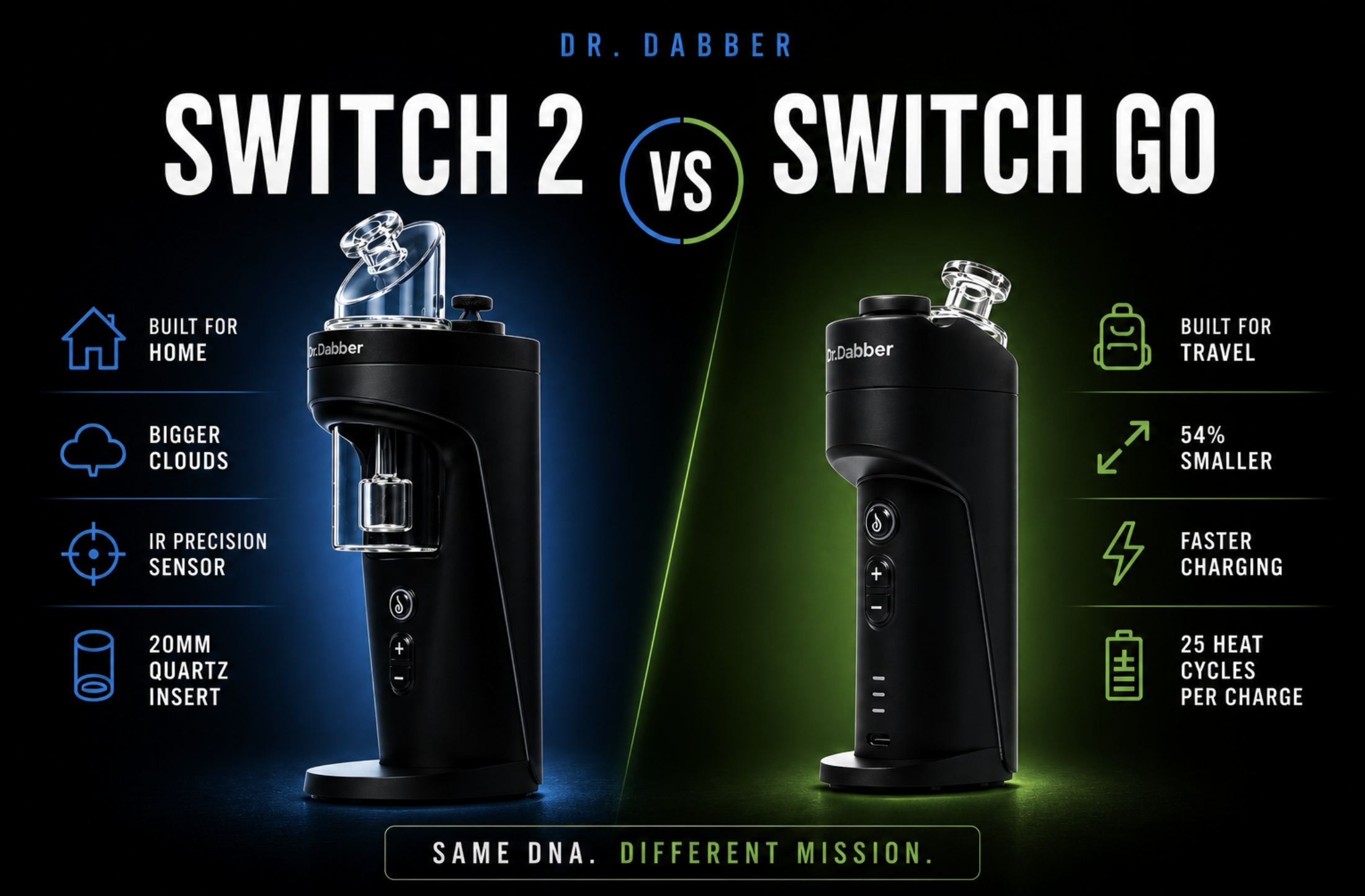
The Switch 2 is a tabletop powerhouse and was the first e-rig ever built with an integrated IR sensor. It took the guesswork out of temperature control, delivering real-time monitoring with every hit. That patented tech changed the game for precision dabbing by dialing into exact temps, controlling your session, and getting consistent results whether you're chasing terps or blowing clouds.
Then came the Switch Go, built with a different goal in mind. 54% smaller than the Switch 2, portability is what makes this device stand out. It gets roughly 25 heating cycles per charge, making it a legitimate on-the-go option without sacrificing the core Switch experience.
In use the two feel noticeably different. Both are designed to deliver long, consistent draws with maximum airflow per pull. On the Switch 2 you're immediately met with a full wave of flavor, where terpenes hit with power and vapor production earns the "tabletop powerhouse" label. On the Switch Go the flavor is still punchy, but more dialed back. Vapor production follows suit: still solid, just not as aggressive. Smaller clouds in public means less attention, which is usually a good thing.
Either way, both sessions will get you elevated. It just comes down to where you want to sesh.
The gap between the two becomes even clearer when you look at the heating technology.
Heating Tech: Where They Diverge
Both devices run on omni-directional induction heating, meaning your material gets hit from the sides and below simultaneously for even, consistent vapor with every pull. They also share three core heating modes: ascent, descent, and steady which are all accessible through the Dr. Dabber app. Both devices also have access to hill, valley, and custom modes through the app, giving users full control over how heat builds throughout a session.
The Switch 2 uses a 20mm quartz insert which is a 300% volume increase over the original Switch. However, the Switch Go runs a smaller 14mm single crystal quartz insert. The larger insert on the Switch 2 handles bigger dabs with ease and retains heat better, but requires more cleaning after sessions. The Switch Go's smaller insert is more prone to reclaim buildup over time, but easier to maintain and perfectly suited for the portable use case.
Worth noting: like the original Switch, the Switch Go is compatible with both concentrates and dry herb. Just swap the quartz insert for a titanium one when you're working with flower, hash, kief, or moon rocks.
Portability & Battery
The Switch Go is 54% smaller than the Switch 2 while keeping the same tapered profile and mouthpiece, making it the obvious pick for anyone who isn't dabbing exclusively at home. It charges faster too, at 45 to 60 minutes versus the Switch 2's 60 to 90, and gets roughly 25 heating cycles per charge.
Imagine this: you're heading out on a backpacking trip and want to get elevated in the woods. The Switch 2 will give you more volume per session, but your overall experience on the trail would be better with the Switch Go because it’s easier to carry, more compact, and way more accessible. While technically the Switch 2 isn't a stationary concentrate vaporizer, it acts like one with its bulky build and tabletop-first design. It's a device that rewards a dedicated setup - a tray, a surface, a vibe. The Switch Go strips all that away and puts the same core experience in your pocket.
On the flip side, if you're into home sessions where you're blowing fat clouds while your dog quietly judges you and you've got nowhere to be, then the Switch 2 is a no-brainer. Full flavor, biggest clouds, zero obligations. Sounds like a perfect day.
Both devices support pass-through charging, so you can hold a session while plugged in on either. The Switch 2 takes longer to charge given its size, but as a tabletop device that's rarely a dealbreaker.
App & Customization
The Dr. Dabber app is a staple across the Switch series. Both devices use it for adjusting temperature profiles, lighting, session times, and battery monitoring. Beyond the three core modes shared by both devices: ascent, descent, and steady, the app also unlocks hill, valley, and fully custom profiles on both the Switch 2 and Switch Go.
Hill and valley are where it gets interesting. Unlike ascent and descent which are linear heating curves, hill and valley are non-linear waveforms that shape the entire session experience rather than just ramping a temperature
Hill mode gradually climbs to a peak mid-session then descends for a smooth, flavorful finish. This mode is best for high-end live rosin where you want terpene preservation at both ends of the hit. Valley mode does the opposite: it starts at your set temp, dips in the middle, then climbs back up for a strong finish. This is perfect for large dabs or globs where the mid-session drop prevents the oil from boiling over and gives a satisfying two-stage feel.
The app also lets you:
Save up to 5 temperature presets with custom hold times
Track battery level, total dab count, and live dish temperature
Customize LED themes, brightness, and haptic feedback
Run cleaning mode cycles to burn off residue
Build and share custom heat profiles with a share code
Shared Features Worth Noting
Despite the price of $299.99 for the Switch Go and $349.99 for the Switch 2, both devices are money savers long term. Neither uses atomizers, so there are no burnt-out coils to replace like with traditional concentrate vaporizers. Both run on electromagnetic induction heating that envelops the extract without direct contact, keeping the experience clean and consistent session after session.
Both devices also feature internal RTD sensors that support temperature stability and protect against overheating which is a detail that matters more than it sounds when you're running precision heat profiles.
Then there's the illuminated water chamber, one of the more visually distinct elements of the Switch design. It lets you monitor your session in real time while setting the mood with customizable lighting. Both devices also share the same mouthpiece and magnetic carb cap because you don't fix what isn't broken. The design was intentional on the Switch 2, and it was good enough to carry straight over to the Go.
Who Should Buy What?
The Switch 2 is built for the home setup, and is ideal for habitual cloud chasers and flavor enthusiasts who want precision in every puff. The Switch Go is for everyone who refuses to be confined to a couch. It's a serious tech piece in a smaller format, built for the person who wants the full Switch experience wherever they end up.
They're fundamentally different devices with different purposes. The question isn't which one is better, it's which one fits your life. Choose your device and puff like no one’s watching.




 Uwell
Uwell RAZ
RAZ SMOK
SMOK Geek Vape
 Vaporesso
 Geek Vape
 SMOK
SMOK UWELL
UWELL
 FOGER
FOGER Lost Mary
 FASTA Vapes
 Fifty Bar
 Juice Head E-Liquid
 Pod Juice
 Monster Vape Labs
 Naked 100


 Lost THC
 Flying Monkey
 BOUTIQ
 ELF THC


 YoCan
YoCan Lookah
 Dr. Dabber
 PuffCo
 OEO
OEO NIQ
NIQ VELO
VELO MELTA
MELTA
 MJ Arsenal
 Puffco
 GRAV Labs
 EYCE
EYCE
 Cohiba
 Arturo Fuente
 Davidoff
 My Father
 Nitecore
 Hohm Tech
 UWELL
UWELL LUCY
LUCY