Cigar Storage Guide: Humidity, Temperature & the 133–140 Rule
Posted:July 08, 2025
AGE VERIFICATION
The products available on Element Vape are age-restricted and intended
for adults of legal smoking age only. All orders placed on the website will
be verified by an industry leading Age Verification software for validation.
By entering our website, you affirm that you are of legal smoking age in your
jurisdication and you agree to be Age Verified.
Cigars are delicate, nuanced, and highly sensitive to their environment. Much like fine wine or artisanal cheese, they demand specific storage conditions to preserve their flavor and mature gracefully over time. Too much moisture? Expect uneven burns or the dreaded onset of mold. Too little? Your cigars could dry out, crack, or burn hot and harsh—robbing you of the experience you paid for. Humidity plays a central role in keeping your cigars in peak condition, while temperature is equally critical, helping to prevent the dreaded tobacco beetle infestation and encouraging a stable aging process that unlocks deeper flavor complexity.
Maintaining cigar integrity isn’t guesswork — it’s science. Achieving the ideal storage conditions involves controlling four environmental variables with precision and consistency: relative humidity, temperature, light exposure, and airflow. Here's a closer look at each factor and how to manage them effectively.
Every premium cigar requires:
Relative Humidity: Relative humidity is how much moisture is in the air compared to how much it could hold at a given temperature. Think of it like a glass that's partly filled with water. If the glass is full and cannot hold anymore water, we are at 100% relative humidity. If the glass is half-full, we are at 50% relative humidity. Cigars like to stay around 70% relative humidity.
Temperature: Cigars like to hang out between 62°F to 70°F. If temperatures rise above that range, any cigar beetles and their eggs will become active, potentially ruining your entire stash. If it becomes too cold, cigars can lose their flavors, complexity, or even age unevenly.
Darkness: Exposure to the sun or even ambient lighting can dry out wrappers, fade colors, or conflict with the oils that give cigars their flavors. Cigars should be shaded from UV rays, best left alone in a cool dark place to prevent light exposure from aging the cigars in a bad way that can lead to a boring and flat smoke.
Airflow: Cigars require airflow, preventing stale air from being trapped within. This retards mold growth and helps balance uneven humidity within the humidor. Proper airflow is crucial to keeping moisture levels balanced, preventing sections of increased moisture from harming a cigar's flavor or cause uneven burn issues.
When it comes to cigar storage, darkness and airflow are the easiest boxes to check — just keep your cigars out of direct sunlight and make sure there’s enough air circulation to prevent mold. But humidity and temperature? Those are the tricky ones. They’re constantly shifting with the seasons, the room you’re in, or even how often you open your humidor, and getting them just right takes more effort and attention. While I’ve shared general target ranges for both, those numbers are really just a starting point. To properly care for your cigars — especially if you’re aging them — it’s important to understand how humidity and temperature work together. The two are deeply connected, and managing that relationship well can preserve your cigars’ quality… or, if neglected, quietly compromise it over time.
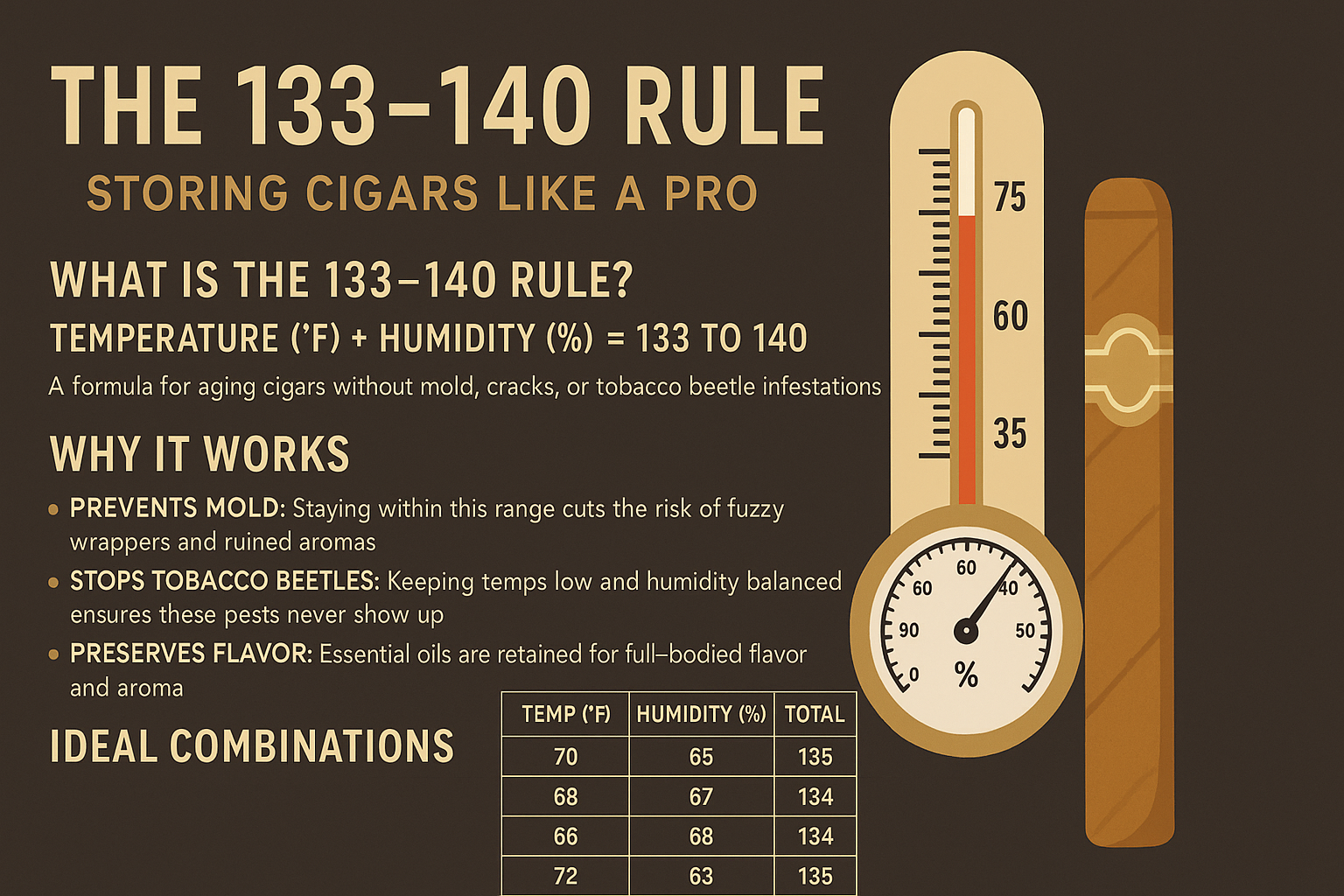
What Is the 133–140 Rule?
So you’ve picked up your first cigar and fallen in love with the experience. You even took the time to find a proper humidor—one that suits your budding collection. But now you're hearing terms like “relative humidity (RH),” “temperature fluctuations,” and “Boveda control packs,” and suddenly, things feel more like a science class than a smoke break. You came here to enjoy cigars, not crunch numbers. Still, remember when they said math would be everywhere? They weren’t wrong—but don’t worry, this isn’t calculus. There are no intricate formulas or confusing theorems to memorize—just a simple sum of two numbers. If that number falls within a certain range, you’re golden.
Want to keep your cigars in perfect condition? Here's the Golden Formula:
Temperature (°F) + Humidity (%) = 133 to 140
Now, this isn’t my rule, rather, it’s a blend of ideas I picked up while researching the best ways to care for cigars. Some people swear by the 135 Rule, others by the 140 Rule. Personally, I don’t think one is better than the other—so I thought, why not combine them?
This isn’t just cigar math—it’s a foundational rule for aging cigars without mold, cracks, or a surprise tobacco beetle infestation.
While some enthusiasts obsess over hitting exactly 70°F and 70% RH, the 133–140 range offers more flexibility—and more realism. Outside of high-end setups with precision climate control, temperature is rarely stable. That’s why this method is better suited for the everyday smoker with a normal budget and a practical humidor.
If your temp dips slightly, you can offset it with a bump in humidity—and vice versa. It’s a more forgiving formula, especially in storage environments that shift with the seasons.
One more thing: Old World and New World cigars often thrive under slightly different storage conditions. Instead of chasing two separate ideals, this approach gives you a sweet spot that works for both—because if you’re anything like me, you probably appreciate cigars from anywhere on the globe.
Cigar-Type Storage Tips
Cuban Cigars (Old World): Ideal around 65% RH at 66°F (Total = 131). Slightly under, but safe.
Non-Cubans (New World): Comfortable up to 70% RH at 70°F (Total = 140 max).
Ideal Combinations
Here’s how seasoned collectors apply the rule in practice:
Temp (°F)
Humidity (%)
Total
70
65
135
68
67
135
66
68
134
72
63
135
Pro tip: Most seasoned collectors aim for 67–69% RH at 68–70°F.
The Final Puff
I’m not reinventing anything here—just sharing the middle ground I’ve chosen for my own collection. As I continue learning and enjoying cigars from every corner of the globe, I have to consider not only what’s already in my humidor but also what I plan to add down the line. That’s why I’ve adopted the 133–140 Rule—it gives me the flexibility to accommodate both New World and Old World cigars without overcomplicating my setup.
This range gives me breathing room. It accounts for natural fluctuations in temperature and humidity—especially helpful when you’re not running a perfectly climate-controlled cabinet. Rather than chasing a rigid ideal, I’m aiming for consistency within a smart, adaptable range that works across the board.
It’s a practical, realistic approach that lets me age and store cigars with confidence—no matter where they come from, or what’s next on the acquisitions list. (And yes, I absolutely have an acquisitions list.)
Share with us your humidor problems, tips, and tricks in the comments section below. Be sure to add more supporting information, like if youre in a particularly damp or dry area that could affect cigar storage.
Quick Reminders
Use a digital hygrometer + thermometer combo—accurate and essential.
Monitor, don’t obsess—stability matters more than precision.
If unsure, aim for the low end (133–135) for long-term aging.




 Uwell
Uwell RAZ
RAZ SMOK
SMOK Geek Vape
 Vaporesso
 Geek Vape
 SMOK
SMOK UWELL
UWELL
 FOGER
FOGER Lost Mary
 FASTA Vapes
 Fifty Bar
 Juice Head E-Liquid
 Pod Juice
 Monster Vape Labs
 Naked 100



 Lost THC
 Flying Monkey
 BOUTIQ
 ELF THC


 YoCan
YoCan Lookah
 Dr. Dabber
 PuffCo
 OEO
OEO NIQ
NIQ VELO
VELO MELTA
MELTA
 MJ Arsenal
 Puffco
 GRAV Labs
 EYCE
EYCE

 Cohiba
 Arturo Fuente
 Davidoff
 My Father
 Nitecore
 Hohm Tech
 UWELL
UWELL LUCY
LUCY