Do Cigars Get Better With Age? A Complete Guide to Aging Cigars
Posted:August 13, 2025
AGE VERIFICATION
The products available on Element Vape are age-restricted and intended
for adults of legal smoking age only. All orders placed on the website will
be verified by an industry leading Age Verification software for validation.
By entering our website, you affirm that you are of legal smoking age in your
jurisdication and you agree to be Age Verified.
Spend enough time at any cigar lounge and the topic is sure to come up. The neverending debate on aging your cigars. One guy swears by the five-year mark, cigars get extra delicious with time. Another says there's no real point to aging. The owner is telling you about how he's aging a box "for retirement". You want to believe or trust these folks, as many of them have had more experience with cigars than yourself. However, understand, there is no single answer that is correct, or incorrect. But, there are definitely some concrete truths when it comes to aging cigars, some more applicable than others, depending on your storage practices, patience, and the type of cigar you are attempting to age. Aging can add some complexity to your cigars, allowing the flavors to meld together, forming an extraordinary cigar, or strip away everything you loved about it in the first place.
Myth vs Reality: Does Aging Cigars Improve Flavor?
Yes, aging cigars can improve certain blends. Over time, the harsher aspects of the smoking experience mellow out, flavors integrate more harmoniously, and the sharp “bite” of nicotine softens. But there’s a catch — not every cigar benefits from long-term storage or aging.
Your favorite full-bodied cigar might lose its signature boldness with time, while a mild cigar can mellow into something that’s smooth but nearly flavorless. Cigars don’t have an expiration date, but most reach their “sweet spot” within 1–5 years. Beyond that, flavors often begin to fade, and the unique character that made the cigar special in the first place can diminish.
The Science Behind the Smoke - What Happens During Aging?
Chemical Transformation: The Marriage of Flavors During proper aging, cigars undergo a slow yet profound chemical transformation. Resting in a humidor, natural enzymes within the tobacco leaf continue to refine and balance the volatile oils, compounds, and aromatic terpenes inside. Ammonia — a natural byproduct of fermentation — gradually dissipates, taking with it sharp, lingering notes and other harsh compounds that can leave an unpleasant edge on the palate. As these rough elements fade, the tobaccos within the blend begin to “marry,” allowing their individual characteristics to unify into a richer, more complex, and layered smoking experience.
Smoother Profile: From Sharp to Silky Freshly rolled cigars can sometimes have a raw, prickly edge — the kind that delivers a sharp punch to the throat. Aging softens these rougher edges. Over the course of months or years, tannins mellow and the cigar’s overall pH shifts, producing a smoke that feels polished, rounded, and far more inviting. Much like wine or whiskey, where younger bottles often carry a stronger “bite” than their well-aged counterparts, a matured cigar offers a smoother, more refined draw. As the layers of flavor meld together, they create a depth and harmony that’s nearly impossible to replicate in a fresh stick.
The Head Start: Factory Aging Most premium cigar makers actually give their tobacco a significant head start with cigar aging processes — sometimes months, sometimes years — before it ever reaches your humidor. Brands like Plasencia, Arturo Fuente, and Davidoff are masters of this craft. The Plasencia Cosecha 151 San Diego Cigars uses tobaccos harvested in 2016, aged for over five years before rolling, creating a refined, well-integrated profile from the very first puff. Arturo Fuente applies the same meticulous care to its Hemingway Best Seller line, aging the tobaccos for years in cedar-lined rooms, then resting the rolled cigars even longer so the blend has time to stabilize and the flavors can fully marry. Davidoff takes aging to an extreme, with certain special editions using leaves that have been aged for up to a decade before rolling, followed by extended post-roll aging to achieve perfect balance and harmony.
This means your home aging isn’t starting from scratch — it’s building on years of careful preparation, fermentation, and patience by the manufacturer, with the final refinements happening under your care.
When Aging Helps the Cigar:
Some cigars age better than others. As a general rule, you should always taste a cigar before committing it to long-term aging — this gives you a baseline to gauge how it might develop over time. Aging is a time-consuming process, and not every stick will reward your patience.
Cigars that often benefit most from aging include:
1. Young, bold, full-strength blends with noticeable harshness on the palate. 2. Maduro, oscuro, or other oily, dense tobaccos that have more depth and richness to unlock. 3. Complex, well-constructed premium cigars that have already seen some factory aging but still deliver a punch straight out of the box.
These types are the best cigars to age and tend to evolve beautifully in the humidor. That said, I personally wouldn’t push aging much beyond two years — past that point, you risk losing the vibrancy and punch that made the cigar special in the first place.
When Aging Hurts the Cigar:
Cigar aging isn’t for every stick. Some milder blends simply don’t benefit from the process. A prime example is the Connecticut Shade wrapper cigar — these lighter wrappers tend to lose their subtle complexity over time, fading into a one-dimensional profile of paper and hay.
Aging can also work against infused cigars. The flavored elements that make these cigars unique will dissipate long before the tobacco itself has time to develop in the humidor. While the base tobacco may eventually mature, most aficionados buy infused cigars for the added aromas and flavors — not to let them fade away while waiting for the underlying leaf to age.
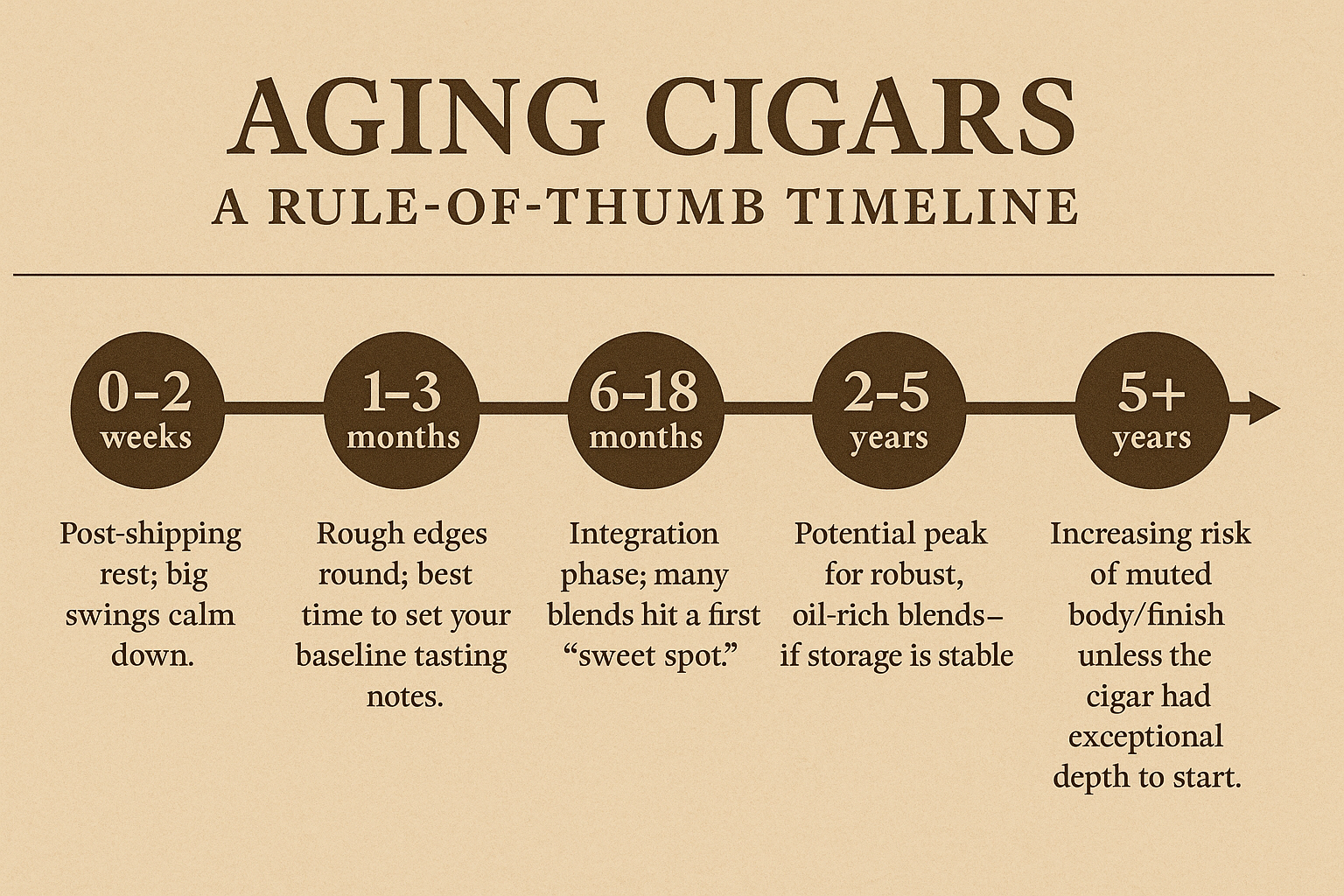
Take a peek at the cigar timeline below for a clearer idea of how to age them. Just remember — this is a rule of thumb, not a hard-and-fast cigar aging law.
How To Age Your Cigars: The Proper Environment
Aging cigars isn’t just about patience — it’s about precision. The right environment is essential. Improperly stored cigars won’t age gracefully; instead, they’ll dry out or fall victim to mold. An unstable humidor, whether in humidity or temperature, can derail the entire process, creating perfect conditions for damage rather than refinement. For optimal aging, maintain a temperature of 65–70°F and a relative humidity of 62–65%.
Why these settings matter: Temperature and humidity work together to control the pace of chemical changes inside the tobacco. Around 65–70°F, the natural enzymes in the leaf remain active enough to break down harsh compounds without accelerating decay or mold growth. Relative humidity in the 62–65% range keeps the tobacco’s moisture stable — just enough to preserve the oils and flavors that develop during aging, but not so high that it risks swelling, splitting, or fostering mold. These conditions essentially “pause time” just enough for your cigars to evolve slowly and gracefully.
Humidity & Temperature Matter
Keeping your cigars at the right humidity and temperature is essential for proper aging and maintaining their flavor.
Even small fluctuations can affect burn quality, aroma, and overall enjoyment.
How To Know When a Cigar is "Ready" - The Tipping Point
Aging cigars isn’t an indefinite process. Most aficionados I know say two years is the maximum they’d attempt. Personally, I believe five years is possible for certain blends — but by that point, many cigars will have lost some of their flavorful luster. There’s usually a sweet spot where flavor peaks, and if you go beyond it, you risk losing the vibrancy that made the cigar special in the first place.
A great way to find your own sweet spot is to run a simple taste experiment. Buy multiple sticks from the same box — or purchase a full box of a cigar you love — and age them for different lengths of time. Compare how they taste at various intervals to decide whether aging is even worth it for that particular blend. Check in at regular intervals so you can track how the flavors develop, mellow, or even deteriorate. Remember, while cigars are often compared to wine or whiskey, they behave differently, and the ideal aging length is highly dependent on both the cigar and your personal palate.
I’m running my own test right now with a box of Tatuaje Pork Tenderloin Cigars from the 2025 release. I smoked one fresh to set a baseline, and now the rest are resting in the humidor. My plan is to revisit them over time to see how the flavor develops, changes, softens, or evolves — and to find out firsthand how time treats this particular blend.
The Final Puff
So, does a cigar get better with age? The answer is a resounding yes — but with an important caveat: it’s not a universal truth. As we’ve explored, aging is a chemical journey that can smooth out harsh edges, unify flavors, and unlock a deeper level of complexity in the right cigar. Success depends on three key factors: starting with a well-made premium cigar, maintaining a stable and proper environment, and having the patience to let time work its magic. Darker, richer cigars with natural depth tend to reward the process most, allowing their complexity to mature and shine.
The best way to discover the truth for yourself is to conduct your own aging experiment. Set aside a few sticks from your favorite blends and revisit them after a few months — or even a few years — to see how they’ve evolved. We’d love to hear about your results, so share your thoughts, questions, or aging success stories in the comments below. Who knows? Your experiment might inspire someone else to begin their own journey into the art of cigar aging.
Remember, in the end, cigar aging isn’t just about time — it’s about turning patience into flavor.




 Uwell
Uwell RAZ
RAZ SMOK
SMOK Geek Vape
 Vaporesso
 Geek Vape
 SMOK
SMOK UWELL
UWELL
 FOGER
FOGER Lost Mary
 FASTA Vapes
 Fifty Bar
 Juice Head E-Liquid
 Pod Juice
 Monster Vape Labs
 Naked 100



 Lost THC
 Flying Monkey
 BOUTIQ
 ELF THC


 YoCan
YoCan Lookah
 Dr. Dabber
 PuffCo
 OEO
OEO NIQ
NIQ VELO
VELO MELTA
MELTA
 MJ Arsenal
 Puffco
 GRAV Labs
 EYCE
EYCE

 Cohiba
 Arturo Fuente
 Davidoff
 My Father
 Nitecore
 Hohm Tech
 UWELL
UWELL LUCY
LUCY